
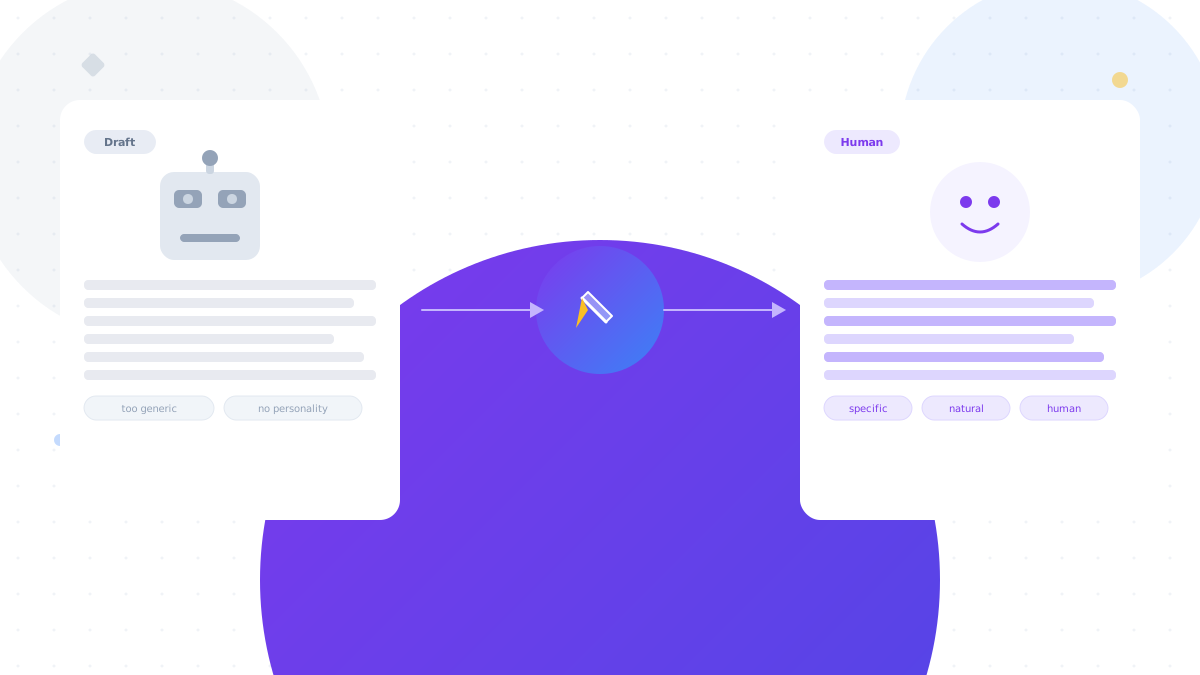
AI writing tools have become genuinely useful. They can help you draft content faster, overcome a blank page, brainstorm ideas and repurpose existing material into different formats. For small businesses with limited time and no dedicated content team, that is valuable.
The problem is not the tools themselves. It is how most businesses use them.
When you ask an AI to write your website copy, your blog post or your social media captions without giving it meaningful context, direction or your brand's actual voice — it fills the gaps with the most average, inoffensive version of whatever you asked for. The result is content that technically covers the topic but sounds like it was written by nobody in particular. Readers feel this, even if they cannot name it.
Use AI for ideas, not final thinking
AI is excellent at generating options quickly — topic ideas, headline variations, structural outlines, bullet points from a rough brief. Where it falls short is in the thinking that sits behind good content: understanding your specific audience, knowing what your competitors are getting wrong, having a genuine opinion and expressing your brand's character.
Use AI to accelerate the mechanical parts of content creation. Keep the strategic thinking, the perspective and the editorial decisions human.
Give AI better context
The quality of what AI produces is directly linked to the quality of what you give it. A prompt like "write a blog post about website design" will produce generic content. A prompt like "write an article for Malaysian SME owners who have a website but are not getting enquiries — focus on the structural and copywriting reasons, not technical issues, and keep the tone practical and direct" will produce something far more useful.
Before running any AI prompt for business content, spend two minutes adding context:
- Who is this for specifically?
- What do they already know or believe?
- What is the one thing this content should help them understand?
- What tone or style should it use?
Better context in means better content out.
Define your brand voice first
AI cannot replicate a voice it has never been given. If you want AI-assisted content that sounds like your brand, you need to define what your brand sounds like first.
This does not need to be a formal document. A few sentences describing your tone — "we are direct but not blunt, knowledgeable but not corporate, practical over theoretical" — is enough to give AI a useful direction. You can also paste in examples of your own writing that you feel represent your brand well.
The more specific the guidance, the less generic the output.
Practical Tip
Start your AI prompt with: "Write in a tone that is [your descriptors]. Here is an example of the style I want: [paste a paragraph of your own writing]." This alone significantly improves the output.
Always edit for clarity and personality
AI-generated content is a first draft, not a finished product. Treat it accordingly.
When editing AI output, look for: sentences that are technically correct but feel hollow, phrases that no real person would actually say, missing specificity that only you can provide, and any place where the content could be more direct or more honest.
Good editing is where your brand personality re-enters the content. It is the difference between "we provide comprehensive digital marketing solutions" and "we help Malaysian businesses get found online and turn that traffic into real enquiries."
Where AI helps most for small businesses
These are the use cases where AI genuinely saves time without sacrificing too much quality:
- Brainstorming article ideas — generate 20 topic ideas in seconds, then choose the three worth writing
- Writing first drafts — get a rough structure on the page quickly, then edit and add depth
- Social media captions — turn a longer article or idea into multiple shorter post variations
- Summarising long notes — convert meeting notes, voice memos or rough ideas into structured drafts
- Planning website sections — ask AI to suggest a logical flow for a service page based on your brief
- Improving FAQs — take your rough answers and ask AI to make them clearer and more readable
- Turning service descriptions into clearer copy — paste in a rough description and ask AI to make it more outcome-focused
Do not publish generic AI content without review
Publishing AI-generated content directly — without review, editing or personalisation — creates two risks. First, it dilutes your brand by making your content indistinguishable from everyone else's. Second, search engines are increasingly able to identify thin, repetitive or undifferentiated content and treat it accordingly.
The goal is not to avoid AI. It is to use it in a way that still produces content worth reading — content that carries your perspective, reflects your experience and genuinely helps the people you are trying to reach.
Keep real examples and human experience
The one thing AI cannot generate is your actual experience. The specific project that taught you something unexpected. The client question you had never been asked before. The observation you have formed from years in your field.
These details — even when brief — are what make content feel real. Add them wherever you can. They are what no competitor can copy and no AI can fabricate.
"AI can make content faster, but it does not automatically make content better. The businesses that benefit most already know what they want to say — AI just helps them say it more efficiently."
Ringkasan Bahasa Melayu
AI memang boleh jimat masa — draft pertama, idea tajuk, outline artikel. Tapi kalau publish terus tanpa edit, hasilnya selalu bunyi generic dan tak ada perasaan.
Pelanggan anda boleh tahu perbezaannya. Yang membezakan kandungan yang bagus dengan yang biasa-biasa adalah suara brand anda sendiri — pengalaman, perspektif, dan cara anda cakap dengan pelanggan.
Guna AI sebagai pembantu untuk draft pertama, kemudian edit ikut suara anda sendiri. Jangan serahkan terus kepada AI dari mula sampai habis.
Industry Note
Google's guidance on creating helpful content explicitly states that using AI to generate content is not inherently problematic — what matters is whether the output is genuinely helpful, accurate and demonstrates real expertise. The issue is not the tool; it is the lack of human judgment applied after it runs. AI-drafted content published without meaningful editing tends to lack the specificity and perspective that makes it worth reading.
MuckaMedia Take
AI can make content faster, but it does not automatically make content better. The businesses that benefit most from AI tools are the ones that already understand their audience, offer, message and brand voice.
Use AI to accelerate. Use judgment to edit. Use real experience to differentiate. That combination produces content that is both efficient and worth reading.
Want to use AI without losing your brand personality?
MuckaMedia helps brands combine smart tools, clear strategy and human copywriting to create better digital content — without the robotic feel.
Talk to MuckaMedia →